
Third Signature:
HeartStrings
Concert Programme:


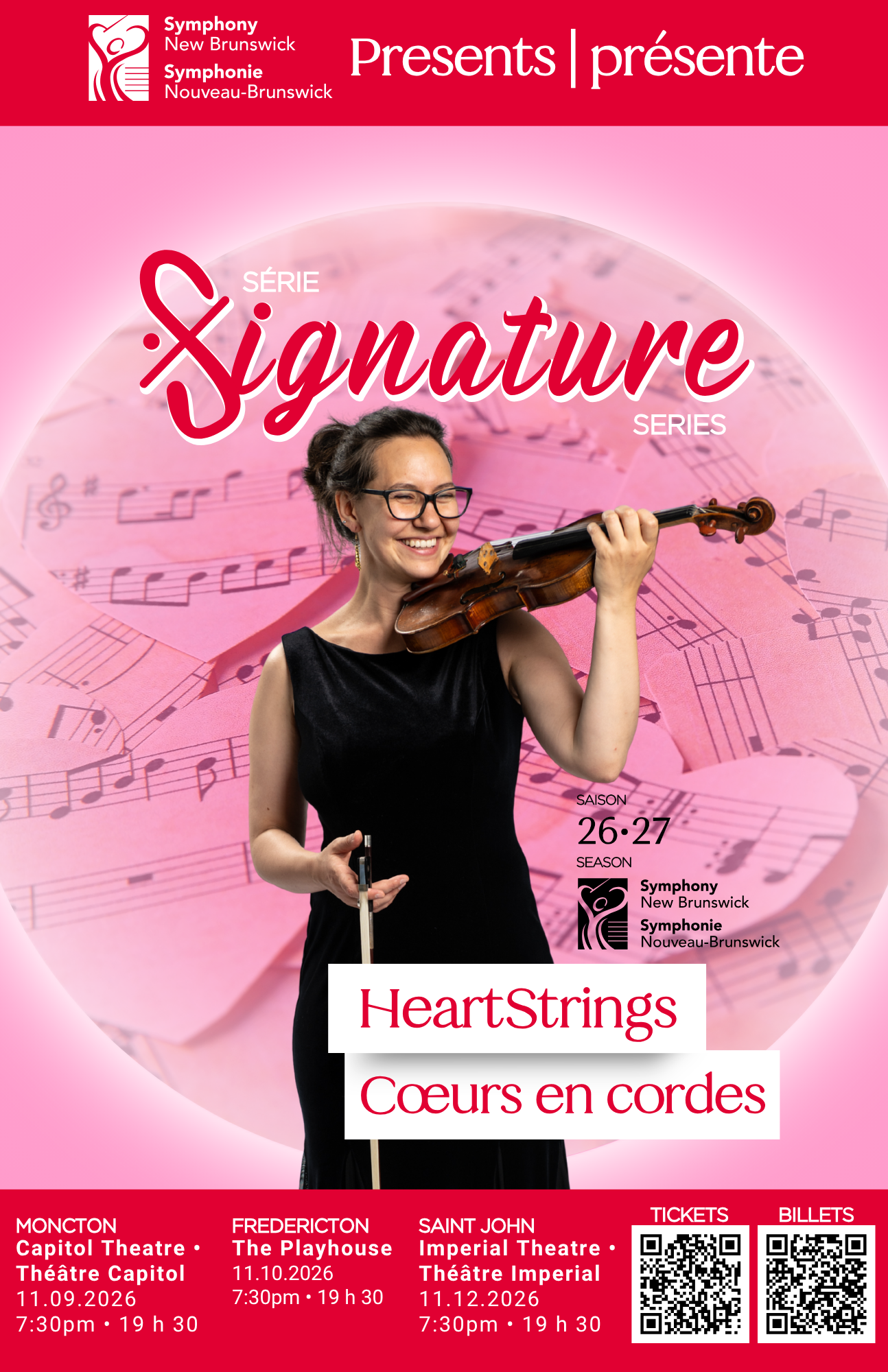
An evening that illuminates the many shapes of love — from yearning and destiny to tenderness and rediscovery.
With Featured Artist Danielle Sametz, concertmaster
-
Danielle Sametz grew up in Regina, Saskatchewan where she began her musical studies on both violin and piano. During her time in Regina, Danielle was a member of the Regina Symphony Orchestra and completed her Associate of the Royal Conservatory of Toronto certification on piano, studying with Dr. Jamie Syer. She received her Bachelor of Music from Brandon University studying with Kerry DuWors and Mark Rudoff and her Masters Degree at the Aaron Copland School of Music in NYC studying with pedagogue Burton Kaplan.
Danielle was a member of the string quartet-in-residence at the Centre for Opera in Sulmona, Italy, was a Saskatchewan representative at the National Arts Program of Canada during the 2009 Summer Games, and has enjoyed performing in South America, France, Ireland, England, Singapore and the Middle East as a soloist, chamber musician and orchestral musician.After living in South Africa and playing with the KwaZulu-Natal Philharmonic Orchestra, she moved to New Brunswick in 2014 to join the Saint John String Quartet and Symphony New Brunswick. She was appointed Concertmaster of Symphony New Brunswick in 2023.
Capitol Theatre
811 Main St.
Moncton, NB
November 9, 2026 @ 7:30pm
The Playhouse
686 Queen St.
Fredericton, NB
November 10, 2026 @ 7:30pm
Imperial Theatre
12 King Sq. S
Saint John, NB
November 12, 2026 @ 7:30pm
Program
click to expand program notes
-
A phenomenon called the “driveway experience” describes becoming so enthralled with a piece of music that the commuter sits in his/her car long after arriving home, listening until the work has finished. Mozetich’s Affairs of the Heart is one such piece. It has become the Canadian composer’s most popular work and has been performed all over the world.
Affairs of the Heart is a 1997 concerto for violin and string orchestra written in one continuous movement in what the composer describes as a post-modern romantic style. This seemingly confusing description alludes to a period of avant garde experimentation by Mozetich following which he found new artistic expression through minimalism. His style, however, is minimalist overlain with neo-romantic flair, setting him apart from the American minimalist school represented by Steve Reich, Philip Glass and others. Still present are the extended thematic lines over a gentle ostinato, a technique that made Arvo Pärt’s Spiegle im Spiegel so famous, but the complexity and melodic beauty of Mozetich’s music gives it a sense of timelessness rather than endless repetition.
The title of the music was not inspired by any specific event or life experience – rather it expresses states of feeling – intimacy, vulnerability, perhaps nostalgia. Some might call it mood music, its weakness being a lack of deep personal or universal intensity found in the music of many other great modern composers. But, there is a place in music for the spiritual, not in an extreme or confrontational sense, but in a peaceful manner by which most of us are moved.
Marjan Mozetich (b. 1958)
Jean Sibelius (1865-1957)
-
The Sibelius suite was written as incidental music for the 1893 tragic play “Pelleas and Mélisande” by Belgian playwright Maurice Maeterlinck (1862-1949). The story is a classic love-triangle between the mystical Mélisande, Prince Golaud of the imaginary Kingdom of Allemonde, and his half-brother Pelleas. Golaud meets Mélisande in the forest and knowing nothing about her, marries her anyway. The girl and Pelleas fall in love with the inevitable result that Golaud kills Pelleas in a fit of jealous rage. Mélisande pines away and mysteriously dies.
More complicated issues underly this simple plot which, without reading the play and delving deeply into its symbolism, can’t be described other than that Maeterlinck’s moral supposedly speaks to the lack of self-awareness or understanding anyone has of anyone else. The story has inspired several other composers, notably Claude Debussy whose 1902 Pelleas and Mélisande is the composer’s only completed opera. Gabriel Fauré and Arnold Schoenberg also wrote incidental music.
The music is scored for a smallish theatre orchestra, without trumpets and heavy brass, but is still recognizable as written by the Finnish composer. As befits the story line, the music is somewhat dark and tense with a few bright moments, mainly in Spring in the Park (Part 4) and the aptly-named Pastorale (Part 6) based on a lovely theme first presented by the clarinets.
Richard Wagner (1813-1883)
-
Contrary to what one might have thought, the Siegfried Idyll was composed in 1870, prior to completion of Wagner’s opera Siegfried, the third of four operas forming the famous Der Ring des Nibelung. The Idyll’s main theme later appeared in the closing scene of Siegfried. The Idyll is a love letter to Cosima-Liszt-Von Bülow-Wagner, written in a more tender vein than we usually expect from her sometimes bellicose inamorato. It was also a birthday gift to Cosima, first played by members of the Tonhalle-Orchester on Christmas morning at Wagner’s villa at Tribschen, Switzerland. Cosima’s birthday was December 24th, but she celebrated it on Christmas Day. The couple’s son Siegfried was born eighteen months earlier, but the Idyll was also intended to celebrate his birth. If one is confused by Cosima’s compound name, she was the daughter of famed pianist Franz Liszt and husband of the conductor Hans von Bülow. Early in her married life, she became infatuated by Wagner’s music, then by Wagner himself, leaving her husband in 1863 and marrying Wagner in August, 1870.
The Siegfried theme is not the only motif used in both the serenade and the opera. The Siegfried horn call also makes an appearance as does the forest bird song.
As originally written, the small orchestra consists of only thirteen musicians – flute, oboe, two clarinets, bassoon, two horns, trumpet, string quartet and double bass. Wagner intended the music to remain private, but financial necessity caused him to publish it in 1878, expanding the orchestra to make it more marketable. In most modern performances, the original scoring is used but the strings are often doubled.